

Saša Milivojev
MUSLIMS AND ORTHODOX CHRISTIANS ARE NOT ENEMIES
Column, 24.11.2025.
The History of Warmongers Who Turned Brothers into
Enemies
WHO IMPOSES ENMITY?
Hostility between Muslims and Orthodox Christians has
never emerged from religious teachings, nor from natural human
relations. It was engineered, manufactured, and sustained by political
elites, empires, colonial powers, and war profiteers.
Religious difference was never the cause—only the
pretext.
Hostility did not arise from the people, but from those
who turned bloodshed into business.
The fact that churches and mosques were sometimes
destroyed throughout history does not prove that Muslims and Orthodox
Christians are enemies. It proves that empires fought wars, and nations
suffered.
Houses of worship were not demolished by believers who
hated each other, but by armies, authorities, and conquerors who saw
every religion as a threat whenever it suited political interests.
For centuries, ordinary people lived together, traded
together, became godparents to one another. Wars were the work of
empires, not faith.
Thus, the historical destruction of religious buildings
is not evidence of interreligious hatred, but of the political
instrumentalization of religion for conflict.
History does not reveal any fixed pattern of hatred
between Muslims and Orthodox Christians.
The same sultan who granted privileges to monasteries one
year would destroy shrines in rebellious provinces the next—not out of
religious hatred, but because empires act according to interests.
THE OTTOMAN ERA – THE PROTECTION OF THE ORTHODOX CHURCH
Few today wish to admit that the Ottoman Empire formally
guaranteed the survival and continuity of the Orthodox Church, and that
sultans invested in the restoration of monasteries (Hilandar, the
Patriarchate of Peć).
Why?
Because a stable ecclesiastical hierarchy meant a stable
population, and a stable population made the empire easier to govern.
There was no “war between religions” — only pragmatic
imperial policy.
BOSNIA FOR CENTURIES – NEIGHBOURS WHO SHARED BREAD AND
SORROW
For centuries, Muslim and Orthodox families lived side by
side, became godparents, attended one another’s funerals, traded, built
houses together, defended villages from bandits, and shared destinies.
The people did not wage war.
Those who did were always:
• spahis fighting their rivals,
• beys defending their wealth,
• emperors and kings fighting for territory,
• and, of course, foreign diplomats drawing maps for
someone else’s interests.
THE 19TH AND 20TH CENTURIES: WESTERN POWERS INVENT
“ANCIENT HATREDS”
When Austria-Hungary entered the Balkans, its first step
was not school-building but the introduction of a narrative of “ancient
hatred” between Muslims and Orthodox Christians—because a population
that believes it has an enemy will more easily accept occupation
disguised as “civilization.”
The same pattern appeared in 1914, 1941, and the 1990s.
Always the same three motives:
• divide the people,
• push them into war,
• fill the pockets of those who sell weapons and
politics.
In the Russian Empire, the Soviet Union, and modern
Russia, Muslims (Tatars, Bashkirs, Chechens, Dagestanis…) and Orthodox
Christians have lived in the same state for centuries.
Some of the most powerful generals of the 19th-century
Russian army were Tatars.
Lenin’s guard had commanders of Muslim origin.
Today, Russia has Muslim ministers, governors, and war
heroes.
If “ancient hatred” were natural, how is it possible that
the world’s largest Orthodox country has 25 million Muslims and
functions normally?
This alone demolishes the myth of an inherent religious
conflict.
In Egypt—the largest Arab country—10% of the population
are Christians, and not Catholics or Protestants but Orthodox (the
Coptic Church).
During the 2011 revolution, Muslims formed human shields
to protect Coptic churches from attack, while Copts stood guard around
mosques.
Who incited conflict?
Always the same: extremists, colonial powers, political
factions seeking chaos.
Never the people.
RELIGIOUS LEADERS AS SILENT ACCOMPLICES — QUIET, BUT
PROFITABLE
Muftis and bishops did not start wars, but many remained
silent when they should have spoken, spoke when they should have
remained silent, and whispered to politicians what those politicians
wished to hear:
“God is on your side.”
That is the greatest sin.
Not war — but the abuse of faith in the name of nation,
leader, or interest.
Did any religion ever command the killing of one’s
neighbour?
— No.
But religious institutions have too often taken the side
of the powerful, because the powerful finance their palaces, cars,
schools, travels, and influence.
There is no hatred in religion.
There is plenty of it in institutions, because
institutions have never been poor.
WHO PROFITED?
In every conflict between Muslims and Orthodox
Christians, the beneficiaries were:
• arms dealers,
• foreign powers drawing borders,
• politicians who need an enemy to survive,
• tycoons who buy whatever burns or collapses,
• religious leaders seeking greater influence.
And who lost?
Always the same: the people. The same people who, the day
before war, shared meals, feasts, slavas, Bajrams, weddings, and
mourning.
THE ŠAJKAČA AND THE HIJAB
I do not understand why the world is shocked by a
photograph of Sava wearing a šajkača and Nadija wearing a hijab, wrapped
in an embrace.
Why should this be strange? Why offensive? To whom?
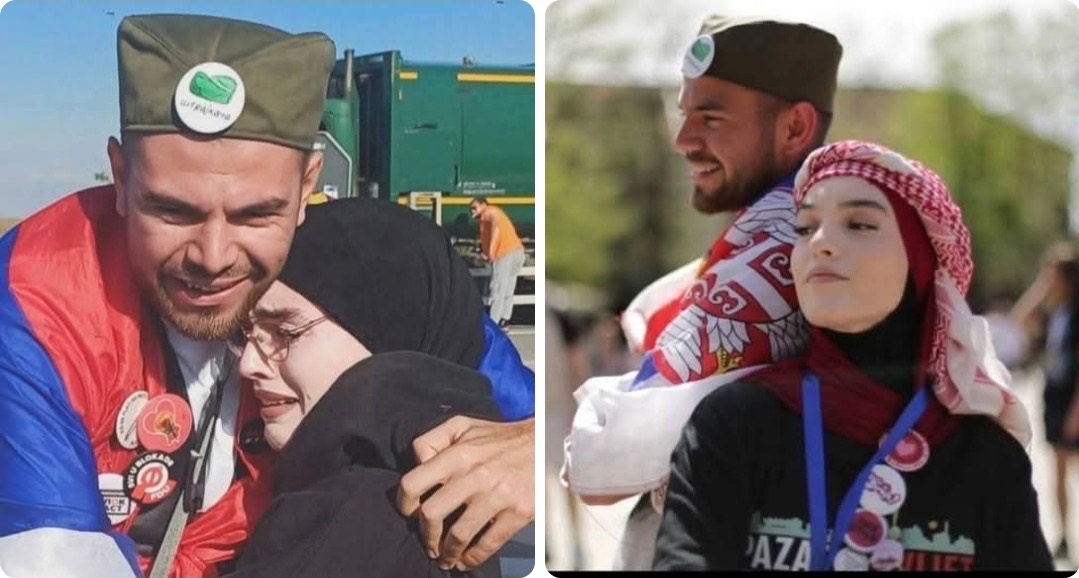
It bothers only those who live off conflict.
It bothers politicians who build careers on “defending
the nation.”
It bothers religious extremists who forget that their
faith preaches humanity, not flags.
It bothers media outlets that turn every difference into
scandal.
It bothers the army of war profiteers who, for centuries,
have sold the same lie:
“The Other is a threat.”
It does not bother ordinary people.
To them, it is normal.
Those who condemn the image of Sava and Nadija are not
condemning the image—they are condemning peace.
They are condemning everything that shatters their myths.
Their discomfort is not caused by the photograph, but by
what it reveals:
People recognize one another—
and love one another—
without the permission of institutions.
And that terrifies them.
Because when people see each other as human beings, all
myths collapse.
“BUT THE TURKS SLAUGHTERED SERBS FOR CENTURIES” — AND
YET…
Some may say, “The Turks slaughtered Serbs for
centuries”—as if that invalidates everything above.
But it does not, because the Ottoman Empire was an
empire, not a religious army:
• they executed Christians when they rebelled against
state authority,
• they executed Muslims when they rebelled,
• they executed Albanians, Kurds, Armenians, Arabs—anyone
who posed a political problem,
• in Bosnia, Muslim beys killed other Muslims more often
than Christians,
• in Anatolia, Turks fought wars against Turks.
This was never Islam against Orthodoxy.
It was the empire against rebellious populations.
The narrative of inherited enmity is a business model,
not historical reality.
MUSLIMS AND ORTHODOX CHRISTIANS DO NOT HAVE A HISTORY OF
HATRED — ONLY A HISTORY OF MANIPULATION
Enmity is not ancient; interest is.
If people once again saw one another as human beings, as
neighbours, rather than as statistical categories, they would defeat
politicians, war profiteers, foreign embassies, muftis, and bishops
alike.
For the greatest secret of the Balkans is simple:
The people do not hate each other.
We are hated by those for whom peace brings no profit.